Digestive symptoms were common in the STEP trials of once-weekly injected semaglutide, but their clinical meaning depends on what was counted. The percentage of people reporting nausea is not the percentage experiencing a serious complication. The typical duration of one episode is not the length of time a person will have symptoms overall. And losing weight while reporting nausea does not establish that nausea caused the weight loss.
A post hoc analysis of STEP 1–3, with a separate examination of STEP 4, helps untangle those questions. Its central finding is that substantial weight loss occurred both with and without reported gastrointestinal adverse events. Reading that finding responsibly requires following the evidence from symptom collection through statistical modeling, while keeping the study’s selected populations and current safety warnings in view.
STEP 1–3: common gastrointestinal events with semaglutide or placebo
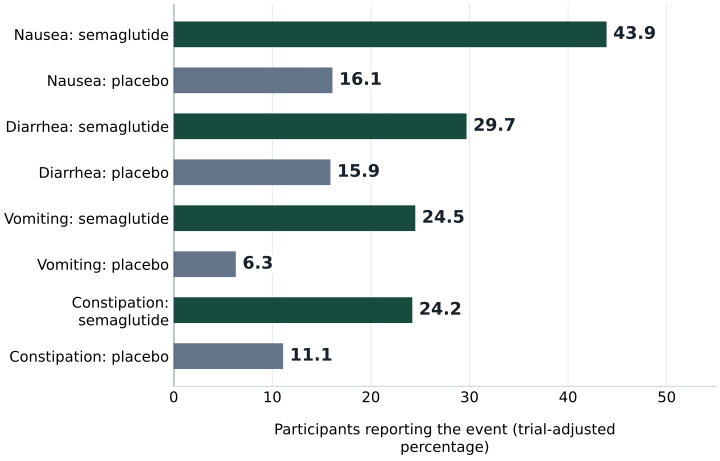
This post hoc analysis pooled three 68-week trials with 2,117 participants randomized to weekly subcutaneous semaglutide 2.4 mg and 1,262 to placebo. Percentages were adjusted across trials using Cochran–Mantel–Haenszel weights. Events were considered on treatment if a dose had been administered in the preceding 49 days.
A person could report more than one event, so percentages must not be added. These are cumulative event proportions, not weekly symptom prevalence or estimates for a current oral formulation. Confidence intervals were not supplied for these percentages in the reviewed main report. Severe GI events occurred in 4.1% versus 0.9%; common does not mean every event is harmless. Novo Nordisk funded the trials and writing assistance.
Source 1Download the source-labeled chart (PNG) · Download the data (CSV)

| Event and randomized assignment | Reported value |
|---|---|
| Nausea: semaglutide | 43.9 |
| Nausea: placebo | 16.1 |
| Diarrhea: semaglutide | 29.7 |
| Diarrhea: placebo | 15.9 |
| Vomiting: semaglutide | 24.5 |
| Vomiting: placebo | 6.3 |
| Constipation: semaglutide | 24.2 |
| Constipation: placebo | 11.1 |
Sections in this article
A pooled reanalysis, not a new trial
The report combined existing randomized, placebo-controlled STEP 1–3 data. Adults had overweight or obesity; STEP 1 and STEP 3 excluded diabetes, while STEP 2 enrolled people with type 2 diabetes. Eligibility in STEP 1 and STEP 3 required a body mass index of at least 30, or at least 27 with a weight-related condition. STEP 2 required a body mass index of at least 27.
The relevant comparison was once-weekly subcutaneous semaglutide targeting 2.4 mg versus placebo for 68 weeks. These doses identify research arms, not a personal treatment schedule. Lifestyle support accompanied treatment, with intensive behavioral therapy in STEP 3. Pooling increased the safety sample but did not erase differences in populations or background care.
Adverse-event incidence was a supportive secondary safety endpoint in the original trials. The pooled tolerability and mediation analyses were post hoc, meaning developed after the original trial plans, and therefore exploratory. This explanation uses the full primary analysis and main table plus selected current official label sections; supplementary files and original trial protocols were not independently examined. For terminology, see the guide to how GLP-1 medicines relate to gut signals.
Source 1 Source 2How a symptom became an analyzed adverse event
Investigators collected adverse events through open-ended, non-leading verbal questions and followed reported events at later contacts. Records included onset and end dates, with events coded into standardized medical categories. An adverse event is an unfavorable occurrence recorded during research; its collection does not by itself establish that the medicine caused it.
The analysis also depended on exposure windows. For safety, participants counted as on treatment if they had received any study dose within the preceding 49 days. For the descriptive week-68 weight comparison, on treatment meant a dose within the preceding two weeks. Those definitions served different purposes and should not be treated as interchangeable.
Incidence describes whether someone experienced an event during an interval; prevalence describes how many had symptoms at a particular time. Event duration asks a third question. One participant could contribute multiple episodes and several symptom types, so neither an episode count nor a sum of symptom percentages gives the number of distinct affected people.
Source 1Frequency needs a comparator and the right denominator
The trial-weighted proportion reporting any gastrointestinal event was 72.9% with semaglutide and 47.1% with placebo, an absolute difference of 25.8 percentage points. The substantial placebo incidence matters: digestive complaints occurred without active semaglutide too. Randomized comparison helps distinguish the excess associated with assignment from the total symptom burden observed.
The researchers adjusted incidence using weights that accounted for differences between trials. Consequently, dividing the raw pooled participant counts in the disposition table does not reproduce the published weighted percentages. That is a methodological distinction, not necessarily a discrepancy. The common-symptom estimates below use the reported weighted values.
For example, nausea differed by 27.8 percentage points, calculated as 43.9 minus 16.1. That is an absolute difference, not a 27.8% relative increase. These descriptive estimates do not supply a personalized probability, and the accessible numerical text does not provide confidence intervals for these frequencies.
| Digestive event | Semaglutide / placebo | Absolute difference |
|---|---|---|
| Nausea | 43.9% / 16.1% | 27.8 percentage points |
| Diarrhea | 29.7% / 15.9% | 13.8 percentage points |
| Vomiting | 24.5% / 6.3% | 18.2 percentage points |
| Constipation | 24.2% / 11.1% | 13.1 percentage points |
Mostly mild events still included severe experiences
Among gastrointestinal events recorded with semaglutide, 99.5% were classified as nonserious and 98.1% as mild or moderate. Both statements use events as their denominator—not people. A participant could have several mild episodes and one severe episode, so these percentages cannot be translated into a claim that nearly every participant was unaffected by meaningful symptoms.
Severity and seriousness are separate safety classifications. Severity describes intensity; seriousness concerns defined medical consequences. The participant-level finding provides another perspective: 4.1% with semaglutide versus 0.9% with placebo reported severe gastrointestinal events, including nausea, abdominal pain, diarrhea, or vomiting. The absolute difference was 3.2 percentage points.
Thus, the dominant event profile and the smaller severe-symptom group are both real findings. Neither cancels the other. An adequate explanation should preserve both, rather than compress the results into an unqualified claim that treatment was safe or that common digestive symptoms were uniformly minor.
Source 1Early clustering does not mean every episode was brief
First gastrointestinal events clustered during or shortly after the trial’s dose-escalation period. The cumulative proportion experiencing a first event began to level off after approximately week 20. That pattern means fewer previously unaffected participants developed their first event later; it does not mean later episodes stopped occurring.
Estimated median durations of individual semaglutide events were eight days for nausea, three for diarrhea, and two for vomiting. Constipation differed: its median duration was 47 days, compared with 35 days on placebo. The estimates used Kaplan–Meier methods, which account for incomplete observation when estimating time to event resolution.
A median is a distribution’s midpoint, not a recovery deadline. It also does not summarize recurrent episodes or establish when symptoms need assessment. The longer constipation finding is particularly important when interpreting the authors’ broad description of events as transient. Planning for follow-up, rather than assuming every problem ends within days, is the practical interpretation discussed in the follow-up horizon guide.
Source 1Stopping medicine and leaving research were different outcomes
Gastrointestinal events led to dose reduction or temporary interruption in 12.5% of semaglutide participants versus 1.7% on placebo. Permanent treatment discontinuation attributed to those events occurred in 4.3% versus 0.7%, mostly during escalation. These are research outcomes, not instructions for adjusting treatment independently.
The gastrointestinal-specific stopping rate should not be confused with all-cause treatment discontinuation: 16.0% in the semaglutide arm and 19.1% in the placebo arm. Overall discontinuation included other adverse events, consent withdrawal, loss to follow-up, and other reasons. Different reasons can move in different directions even when one adverse-event category is more frequent.
Research retention was higher than medicine persistence. At week 68, 94.8% of semaglutide participants remained in the trial, while 84.0% remained on treatment. Continuing research after stopping medicine helps investigators retain information; it does not mean symptoms were inconsequential. Editorial interpretation: when reviewing service terms, documentary details about follow-up and communication deserve attention. The Ro review is a place to check such terms, not evidence of STEP-like treatment or outcomes.
Source 1Weight loss occurred without reported digestive events
Among semaglutide participants still on treatment with a week-68 weight measurement, average weight loss was substantial whether or not they had reported gastrointestinal events. The differences between symptom groups ranged from 0.6 to 1.8 percentage points across the three trials. These were observed subgroup comparisons, not randomized assignments to nausea or to symptom-free treatment.
The table shows why symptoms are not a necessary marker of weight response in this dataset. However, the comparison excludes people who stopped treatment before that assessment. If intolerant participants were more likely to discontinue, the remaining sample could overrepresent people able to continue despite symptoms. Similar outcomes among remaining participants do not resolve what happened to everyone who started.
The observed overall semaglutide-versus-placebo weight-loss differences were 14.4, 7.6, and 12.7 percentage points in STEP 1, 2, and 3, respectively. Those are selected on-treatment analysis results, not interchangeable with each original trial’s primary treatment-policy estimates. The subgroup patterns also were not a formal demonstration of equivalence.
| Trial population | With any GI event | Without any GI event |
|---|---|---|
| STEP 1: without diabetes | 17.3% weight loss | 15.7% weight loss |
| STEP 2: type 2 diabetes | 11.4% weight loss | 9.6% weight loss |
| STEP 3: without diabetes; intensive behavioral therapy | 17.7% weight loss | 17.1% weight loss |
What the mediation model adds—and assumes
Mediation analysis attempts to separate a treatment’s total effect into a portion operating through a proposed intermediate factor and a portion unrelated to that factor. Here, the intermediate factor was reported gastrointestinal adverse events. The investigators used a natural-effects model with imputation-based estimation, alongside repeated-measures modeling of weight.
The estimated contribution through gastrointestinal events was less than 1 percentage point of the semaglutide-versus-placebo weight-change difference. This is not less than 1% of participants, and not necessarily less than 1% of the overall treatment effect. Percentage points describe the weight-change scale; percent of an effect would use a different denominator.
Randomization strengthens the treatment comparison but does not randomize the intermediate symptom. The model assumed no unmeasured confounding beyond included variables, and symptom timing was not fully incorporated. Its results support a small modeled contribution, not definitive proof of a biological pathway. The figure specifies 95% Wald confidence intervals, but numerical bounds are not available in the accessible text; precise interval estimates should not be reconstructed from that description.
Source 1STEP 4 answers a selected maintenance question
STEP 4 was analyzed separately for good reason. All 902 entrants first received open-label semaglutide for 20 weeks. Only 803 participants tolerating the target dose proceeded to randomized continuation or a switch to placebo: 535 continued semaglutide and 268 switched. This design addresses maintenance among selected tolerators, not starting-treatment risk in an unselected population.
During the run-in, 71.4% reported gastrointestinal events and 44 participants, or 4.9% of entrants, permanently stopped treatment because of them. Ninety-nine entrants did not reach randomization, with adverse events cited for 48. After selection, new-onset gastrointestinal events still occurred in 41.9% continuing semaglutide versus 26.1% switching to placebo, although gastrointestinal-related permanent discontinuations were uncommon.
The related tirzepatide SURMOUNT analysis likewise found weight reduction with and without digestive symptoms, but it is not a head-to-head comparison. Its mediation estimate reached 3.1% of the total estimated weight-reduction effect, a different unit from STEP’s percentage-point result. Different drugs, populations, symptom definitions, and trial designs prevent using these reports to rank tolerability.
Source 1 Source 3Current safety context and the questions still open
Current Wegovy labeling states that semaglutide delays gastric emptying and is not recommended in severe gastroparesis. It warns about severe gastrointestinal reactions, pancreatitis, gallbladder disease, and dehydration-related kidney injury. Persistent or severe abdominal pain, with or without vomiting, warrants prompt clinical assessment rather than waiting for a trial median duration. Rare aspiration reports during anesthesia or deep sedation also make procedure-team awareness important.
Postmarketing reports include ileus, intestinal obstruction, and severe constipation with fecal impaction. Voluntary reports cannot reliably establish incidence or causality. These warnings complement—not replace—the trial frequencies. The STEP injection findings do not automatically transfer to oral semaglutide, other formulations, compounded products, or any provider. The guide to finding the right medication document explains why trial reports and current labels serve different purposes.
Unresolved questions include better prediction of persistent symptoms and whether specific support strategies improve tolerability. This analysis did not randomize fiber, probiotics, dietary strategies, or symptom medicines, so it cannot establish their efficacy. Novo Nordisk funded the trials and writing assistance; three authors were company employees and shareholders. Editorial interpretation: readers can check documentary support terms in the Form Health review, but those terms cannot establish clinical effectiveness or substitute for the missing intervention trials.
Source 1 Source 2Questions about the evidence
Does having no nausea mean semaglutide is not working?
No. In the selected week-68 on-treatment sample, participants without any reported gastrointestinal event still lost substantial weight on average. That supports rejecting nausea as a required sign of response. It does not predict an individual’s outcome, and the symptom groups were not randomized.
Source 1Why do the symptom percentages add up to more than the overall incidence?
The categories overlap. Someone reporting nausea and constipation counts in both symptom rows but only once in the overall group with any gastrointestinal event. Adding the rows therefore counts some people more than once and does not estimate total affected participants.
Source 1Does a 47-day constipation median mean waiting that long is expected?
No. It is a study estimate for individual event duration, not a waiting recommendation. Constipation varied across participants, and current labeling includes severe constipation, fecal impaction, ileus, and obstruction among postmarketing reports. Persistent or severe symptoms need clinical interpretation rather than comparison with a median.
Source 1 Source 2Did the analysis prove that treating nausea leaves weight loss unchanged?
No. It compared naturally occurring symptom groups and modeled potential mediation. Participants were not randomized to an effective nausea-prevention intervention. Establishing whether a particular treatment changes symptoms, persistence, or weight outcomes requires evidence about that intervention, not an inference from the mediation result alone.
Source 1Are these percentages suitable for comparing semaglutide with tirzepatide?
Not as a direct ranking. The STEP and SURMOUNT reports differed in design, participants, exposure, symptom definitions, and analysis choices. Current product-label tables also draw on different trial pools. Neither separate placebo-controlled program establishes which drug would cause fewer digestive symptoms in the same people.
Source 1 Source 3 Source 2 Source 4Editorial assessment
The strongest conclusion is narrower and more useful than either reassurance or alarm alone: digestive events were more frequent with semaglutide than placebo, most recorded events were mild or moderate, and a smaller group experienced severe symptoms or stopped treatment because of them. Substantial weight loss without reported gastrointestinal events, together with exploratory mediation results, argues against treating discomfort as necessary evidence of effectiveness. The analysis does not establish symptom-management efficacy, eliminate selection bias, or replace current safety assessment.
Research access and limitations
The full primary post hoc report and main table were examined, but supplementary files and original trial protocols were not independently reviewed. Current label coverage was limited to selected official sections. Numerical confidence-interval bounds were not available in the accessible text for the principal mediation finding. Post hoc modeling, self-reported symptoms, differing exposure windows, selected on-treatment weight data, and STEP 4’s tolerator selection limit causal and real-world interpretation.
Sources and context
Scientific sources checked October 21, 2026. Earlier research and provider sources retain their dated histories below. Study summaries identify their evidence limits. Provider pages describe advertised offers, not independently measured care performance.
- Gastrointestinal tolerability of once-weekly semaglutide 2.4 mg in adults with overweight or obesity, and the relationship between gastrointestinal adverse events and weight loss.Full primary post hoc analysis main text and main Table 1 reviewed; supplementary file and original trial protocols not independently reviewed. · Checked 2026-10-21
- DailyMed: WEGOVY semaglutide current prescribing informationCurrent official DailyMed label, updated June 18, 2026, current archive June 30, 2026; indications, relevant safety sections 5.2, 5.3, 5.5, 5.6, 5.10, postmarketing experience and oral-drug interaction sections reviewed. Other sections not fully reviewed. · Checked 2026-10-21
- Gastrointestinal tolerability and weight reduction associated with tirzepatide in adults with obesity or overweight with and without type 2 diabetes in the SURMOUNT-1 to -4 trials.Full primary post hoc report, Methods, Results, main Table 1 and Discussion/funding reviewed; supplementary tables and source-trial protocols not separately reviewed. · Checked 2026-10-21
- DailyMed: ZEPBOUND tirzepatide current prescribing informationCurrent official DailyMed label, updated August 28, 2026, current archive September 2, 2026; indications, relevant safety sections 5.2 through 5.5 and 5.9, postmarketing experience and oral-drug interaction sections reviewed. Other sections not fully reviewed. · Checked 2026-10-21